Review - Dispatch
Platinuming games with a toddler, a dog that looks like a cocaine bear, and a work schedule that resembles a game of Tetris is, at the very least, an act of resistance. Every platinum is a declaration that, despite everything, there’s still some space left between the existential crises.
Platinum number 80 came with Dispatch — and it almost didn’t happen.
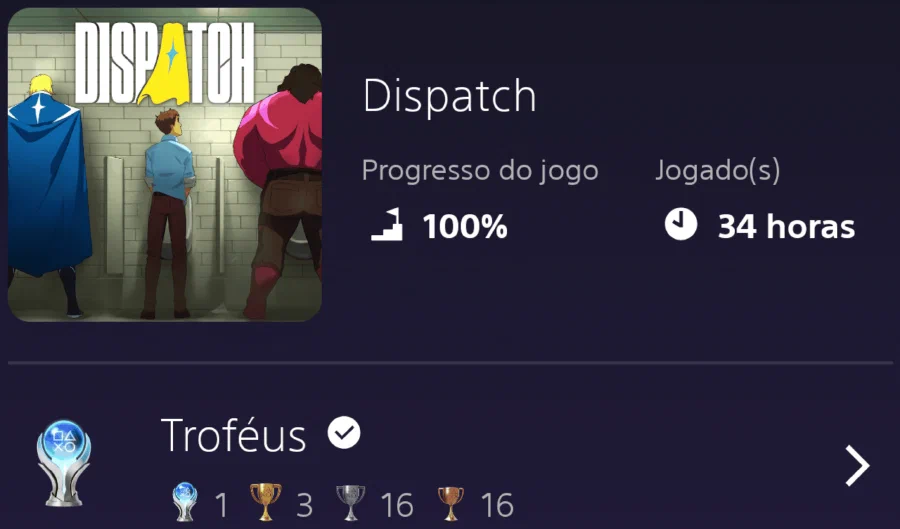
How I almost never played this thing
It all started because I was stuck in Final Fantasy XVI mode. Literally: half an hour a day, snail-pace progress, that nagging feeling that the game would take more months than I have sanity available. It’s not that FFXVI is bad — it’s that its platinum demands a level of devotion bordering on Shaolin monk training.
I stumbled upon Dispatch almost by accident. I was skeptical — this kind of more narrative-driven game, with decisions, dialogue, and the whole “absolute cinema” structure that everyone uses now to describe anything with a decent cutscene. I figured it would be another game I’d start, stare at with a confused look, and shelve in my digital library.
Well.
The opening convinced me to stop. The second chapter convinced me to keep going.
I’ll be honest: the first moments of Dispatch are… lukewarm. That rhythm of “introduce the world, introduce the characters, establish the rules, etc.” Nothing structurally wrong with that — but it’s not the kind of thing that keeps you glued to your seat. I kept going more out of stubbornness than enchantment.
And then the second chapter hit. It convinced me to go to work (no spoilers), I mean, to keep playing.
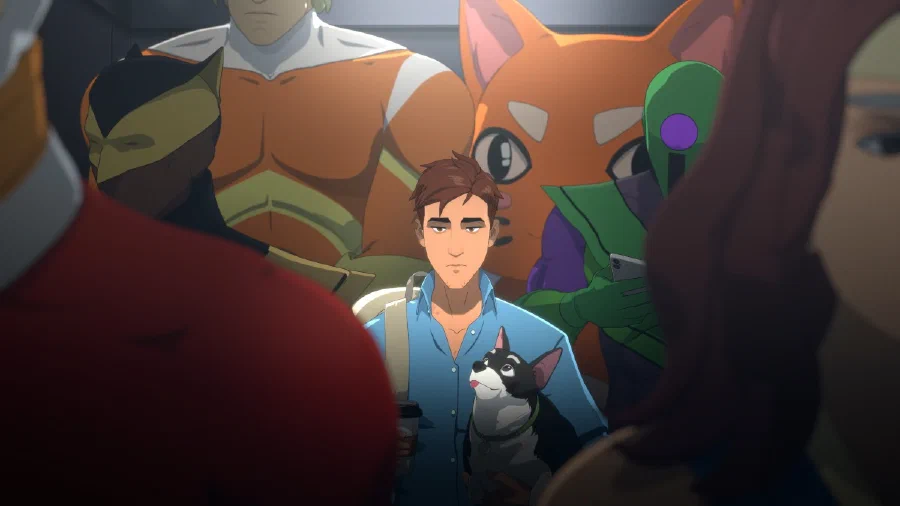
I won’t spoil it further because that would be a crime (even though it’s been out for a while, right?), but the story takes a turn that recontextualizes everything you’d seen before in a way that most Hollywood screenwriters should be forced to study. From the second chapter onward, Dispatch doesn’t let go. You stop playing because you need to sleep, not because the game is over.
The Dispatch mode: chess with superheroes
The central gameplay system — the “dispatch” mode itself — works like a tactical incident management game. You have a team of heroes with distinct abilities, and you need to decide who to send to each situation. Sounds simple. It’s not.
It took me a while to “click” with the system’s logic. I sent the wrong hero to the wrong place more than a few times, with results ranging from frustrating to hilarious. But when it clicks — when you understand the synergy between characters and start reading incidents like puzzles — the mode becomes addictive in an irritating and delightful way (especially if you’re going for the platinum).
It’s the type of system that looks shallow on the surface but has enough depth to keep you occupied well beyond what’s necessary.
The decision system and the multiple-endings problem
Dispatch has a decision system that affects the game’s endings in a way that few narrative titles manage to make feel genuine. Usually, games with “choices that matter” deliver the illusion of impact — you pick A or B, the game changes one scene, and moves forward with the same story anyway.
Dispatch is not like that.
Decisions carry weight and consequences you’ll only understand much later — which is exactly how decisions work in real life, come to think of it (that was unintentionally philosophical of me, apologies, it’s the meds). The script is built with a consistency that makes you want to play again just to see what would have happened if you’d chosen differently.
 That’s one heck of a tough call right there.
The soundtrack and the almost-scatological humor
Two points that deserve a separate mention because they’re better than you’d expect:
Dispatch’s soundtrack is absurdly good. The kind you put on while working and end up staring at your spreadsheet with the look of someone thinking important thoughts, but really just listening to the music.
And the humor: Dispatch has a comedic streak that veers into the absurd and nonsensical at several points — the kind of situational weirdness that catches you off guard and makes you laugh out loud in the middle of the night, waking everyone up. I caught myself laughing at situations that make no sense outside the game’s context but work perfectly within it.
It’s rare for a serious game to be genuinely funny without breaking immersion. Dispatch pulls it off.
TL;DR — Conclusion
Dispatch isn’t perfect. The opening is too slow for anyone with limited patience (and I almost fell into that category). But once the story hooks you, it’s hard to let go.
The platinum was easy enough to avoid being torture and hard enough to feel satisfying. Given my track record of only platinuming games I genuinely love, the fact that I reached number 80 with Dispatch says a lot about what I think of it.
I strongly recommend it for anyone who:
- Enjoys games with a robust narrative;
- Has a bias against narrative-heavy games but wants to be convinced to revise that opinion;
- Is trying to platinum FFXVI and needs something to restore their faith in gaming.
I hope there’s a sequel. And I rarely hope for sequels.
