No One Cares
September arrives, and Brazil turns yellow. Soon enough, we have ribbons on avatars, posts in feeds, talks at work with coffee and sandwiches, and beautiful posts on LinkedIn. October arrives, and it’s pink. November, blue. And we carry on.
Warning: This text discusses depression, suicide, and prevention campaigns. It does not describe methods or graphic details, but if today is not a good day for this topic, postponing it is a perfectly reasonable decision. If you need to talk now, CVV is available 24 hours at 188 and at cvv.org.br .
The question that bothers me isn’t whether people care. It’s why they care so much in September and so little the rest of the year, and why, curiously, those who seem to care the most are often the farthest away.
The Cost of Empathy
We grew up thinking empathy is a moral trait. You either have it or you don’t, like having green eyes or being a Botafogo fan (oops, sorry!).
Experimental psychology provides a less flattering perspective: empathy is work. It costs cognitive effort, and people avoid cognitive effort just like they avoid climbing stairs. Everyone wants to conserve energy.
In a set of studies published in 2019, Daryl Cameron and colleagues did something simple and cruel. They gave people a free choice between two tasks: describing objective characteristics of a photo or trying to feel what that person was feeling. Most chose the first, consistently.
And here’s the detail that changes everything. In the normal scenario, the empathy card was chosen only 35% of the time. Two out of three times, people diverted.
The researchers then manipulated a specific variable: they made participants believe their empathy was working. The preference to avoid empathy simply vanished. The choice became a coin flip.
No one began to enjoy empathizing. People just stopped running away. What held them back wasn’t coldness; it was the suspicion that it wouldn’t do any good.
In other words, the problem wasn’t a lack of kindness. It was a perception of cost and futility.
Add to this Paul Slovic’s work on what he calls psychic numbing. Our compassion doesn’t scale with the tragedy’s size. One endangered child mobilizes. Two mobilize less. A million becomes mere statistics.
It’s not a bug. It’s how the hardware of our brain evolved.
And there’s an even worse layer, discovered by Cameron along with Keith Payne in 2011: part of this insensitivity is chosen. When people anticipate that feeling will come at a cost — that they will be asked for money, time, or involvement — they shut down beforehand. Preventively.
We don’t crumble with compassion before the world because we’ve learned to shut off the tap before we wet our feet.
Compassion Fatigue
There’s a technical term for the exhaustion of caregivers: compassion fatigue. It was coined by Charles Figley in the 90s while studying nurses, therapists, first responders, and other caregiving professions. People who care professionally.
The finding is counterintuitive. Those who suffer from caring too much aren’t the ones who care little. It’s those who care full-time, without breaks, without a rotating schedule.
Now apply this at home.
The spouse of someone with depression is on permanent duty for years. No badge, no shift, no clinical supervision, and no one asking how they are doing. They’ve heard the same phrase five hundred times. They’ve canceled the same trip three times. They’ve had hope only to see hope amount to nothing.
When this person responds with impatience, the easy reading is that they don’t care.
The more probable reading is that they are exhausted.
(And before it sounds like a blanket absolution: there are people who really don’t care. The point is that we confuse the two all the time.)
Campaigns and Campaigns
September Yellow has existed in Brazil since 2014, created by CVV alongside the Federal Council of Medicine and the Brazilian Psychiatric Association. The intention is impeccable. The reach is enormous: just in 2023, CVV registered over 3 million calls to 188.
And the suicide rates in Brazil have increased.
A 2024 study published in the Journal of Affective Disorders analyzed the period from 2000 to 2019 using three different statistical methods and found a 57% increase in the rate, accelerating precisely from 2015. Another study, in Trends in Psychiatry and Psychotherapy, looked at 2011 to 2019 and saw the rate rise from 4.99 to 6.41 per 100,000 inhabitants. Neither study found the protective effect we’d like to see.
Before someone sues me (don’t care anymore): this doesn’t prove that the campaign is harmful. Part of the increase might be better recording (Brazil historically underreports), there was a pandemic in between, and there are also underlying social trends. What can be honestly said is more modest and tedious: the protective effect hasn’t appeared.
Meanwhile, the international literature is very clear on what works. The 2016 Lancet Psychiatry review led by Gil Zalsman identifies two fronts with better evidence:
- Restricting lethal means. Boring, bureaucratic, without a hashtag. When the UK limited the size of paracetamol packages in 1998, a study published in the BMJ estimated 765 lives saved in eleven years;
- Active school programs. In the SEYLE study, involving over 11,000 adolescents across ten European countries, a skills program called YAM (Youth Aware of Mental Health) significantly reduced attempts. Awareness talks for teachers, in the same study, didn’t reduce them.
And there’s media behavior. There’s the Werther effect, where sensationalist coverage increases cases, and the Papageno effect, where stories of people who have crossed crisis reduce them. It’s not folklore; it’s measurable.
Notice the pattern? What works costs money, regulation, and structural change. What doesn’t work costs a yellow ribbon.
Convenient, isn’t it?
The Fallacy of Corporate Mental Health

In the corporate world, the phenomenon has an even funnier version, in the sad sense of the word.
The Great Place To Work (GPTW) published in 2026 that 98% of Brazilian companies consider mental health a relevant topic. Thirty-five percent map psychosocial risks.
A Heach survey with 1,730 respondents found something similar: 78% say they care, 23% have a formal policy with budget and indicators, and 58% admit they only react after absences, complaints, or lawsuits.
Context: over 546,000 workers were absent in 2025 due to mental disorders, the highest number ever recorded in Brazil.
The point of interest is the mechanism. In 2024, William Fleming analyzed data from 46,000 British workers in 233 organizations and found no measurable benefits from individual interventions — mindfulness apps, resilience training, wellness workshops, and other corporate bells and whistles. What moved the needle were working conditions. Workload, hours, autonomy, and management quality.
Translating to the bar table: the company offers you a breathing class to help you cope with the aggressive target it itself set.
By the way, the NR-1 has come into play. Since May 26, 2026, the oversight of psychosocial risks is punitive, and the text explicitly states that internal campaigns and psychological support do not replace documented diagnosis and action plan. The norm, technically speaking, is anti-theater.
Whether it will work is another story. Brazil has about 2,700 labor inspectors for an economically active population of over 100 million people. The International Labor Organization (ILO) recommends close to double that.
Let’s agree that hope here is modest, and the self-esteem of our politicians is quite high.
Circles and People Who Care
Now the part that made me write all of this.
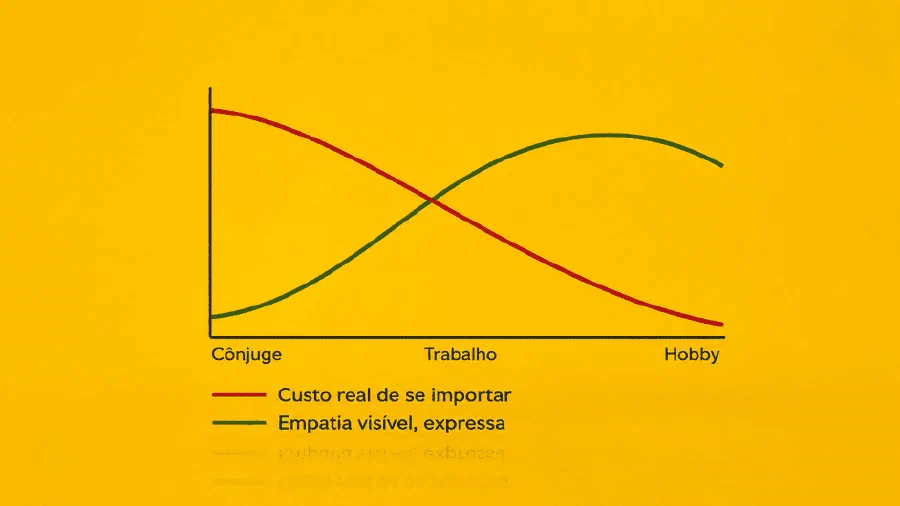
Imagine the concentric circles of your life. You in the center. Then spouse, children, parents. Next, work, friends, the hobby group.
Intuition suggests care is stronger in the center and weakens outward.
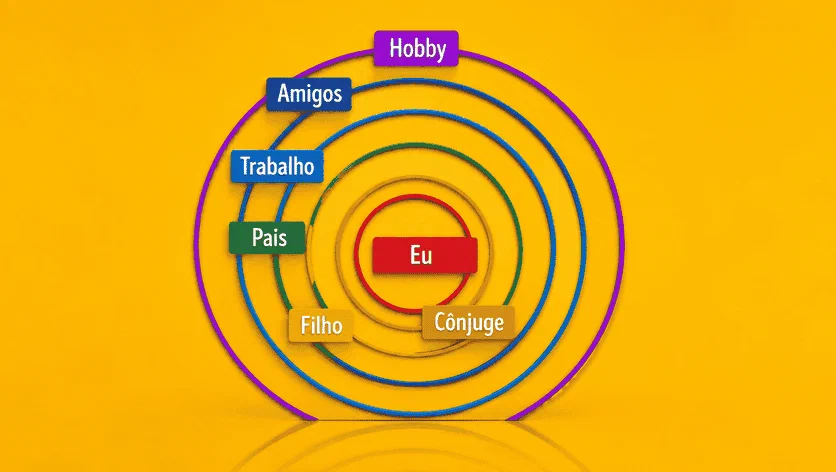
But the experience of those who are unwell often tends to be the opposite. A colleague at work texts you. A friend from the RPG group asks how you are and listens to the entire answer. And at home, where it should be the safe haven, you find impatience, unsolicited advice, and that question no one can stand hearing: “but why don’t you just try?”
There are four things happening here.
The first is the cost we’ve already seen. Empathizing with you costs a message from someone far away and a lifetime’s reorganization for someone close. What we see as care is, almost always, cheap expressiveness.
The second comes from Daniel Batson, who separated two things that appear to be one: empathic concern and personal suffering. Empathy grows with proximity, but when that proximity is at its maximum, your suffering stops being read as yours and becomes a direct threat to the other person’s life. And when someone feels threatened, the response isn’t welcoming; it’s defense, control, and irritation.
Your mom isn’t indifferent. Your mom is terrified.
The third is a delightful bias called closeness-communication bias, studied by Kenneth Savitsky and Boaz Keysar. The closer the relationship, the more we overestimate how well we understand the other. The distant friend genuinely asks because they don’t know. The person sleeping next to you thinks they already know and jumps straight to the solution.
The fourth is information asymmetry. To the outside circle, you send the edited version with a caption and soundtrack. The inner circle watches the raw cut: the bad day, the broken promise, and the rudeness of Tuesday. They’re reacting to a stimulus that’s much harder to love.
Put it all together, and you get a somewhat perverse outcome: those who seem to care the most aren’t those who are farthest away or closest. It’s those at a medium distance. Close enough to know, far enough not to pay the bill.
The stranger on the street doesn’t care. The spouse is exhausted. The colleague is at the optimal point of the curve.
And the studies on stigma, by the way, measure exactly this. Bernice Pescosolido and other researchers assess what is called social distance by asking how much you would accept someone with a mental disorder as a colleague, friend, neighbor, or family member by marriage. Guess where acceptance drops? I bet you got it right.
Abstract tolerance is cheap. Tolerance that binds costs a lot.
It’s All Up To You

We’ve reached that point in the text where I should deliver the motivational pivot. I’ll warn you now: it’s not coming.
But there is a pragmatic conclusion, and it’s somewhat uncomfortable.
If the gradient is structural, if it exists because of cost, fear, and exposure, then auditing who cares and who doesn’t is a costly and unproductive pastime. You will spend energy you don’t have building a ranking of disappointments.
What’s left is less pretty and more useful:
- Stop expecting a single person to cover all shifts. A spouse isn’t a psychiatric intern and never was;
- Distribute the burden among different circles, including the outside ones — they’re available, and that doesn’t make them false;
- Remember there is exactly one relationship where caring is the contracted, trained, and supervised function. It’s called therapy, and it’s the only place where the cost of empathy is already in the budget;
- And, to the extent that it depends on you as the listener: listen until the end before suggesting anything. No one has ever gotten better because of a “but why don’t you try?”
I’ve written here about dysthymia and how Hanna Barbera’s Hardy is the unofficial mascot for those living in shades of gray. I still believe that the hardest part isn’t the diagnosis. It’s the emotional accounting of discovering who cares.
But the honest answer is that almost everyone cares a little, and almost no one cares enough on their own. Including me. Including you.
The title of this text is wrong, and I knew that when I wrote it.
Sources I used to not talk too much nonsense:
- Cameron et al. (2019), Empathy is hard work, Journal of Experimental Psychology: General
- Cameron and Payne (2011), Escaping affect, Journal of Personality and Social Psychology
- Zalsman et al. (2016), Suicide prevention strategies revisited, Lancet Psychiatry
- Damiano et al. (2024), Journal of Affective Disorders
- Fleming (2024), Industrial Relations Journal
- Pescosolido et al. (2021), JAMA Network Open
