Ludonarrative Dissonance in Games
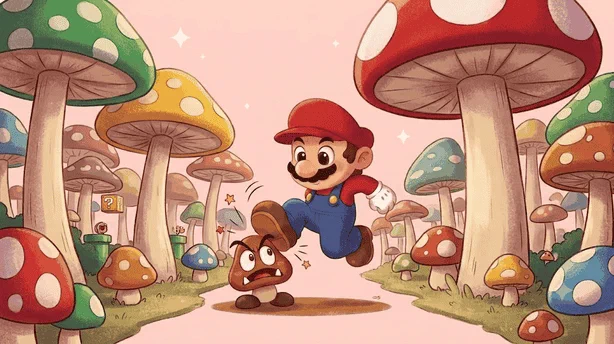
Mario Mario (yes, that’s right) is a plumber. A simple man, with a pompous mustache, a red cap, and a job that, let’s face it, he clearly hasn’t done in a long time. Mario also just smashed, stomped, set fire to, and turned an indeterminate number of living creatures into coins all across the Mushroom Kingdom just to find out the princess is in another castle - and he did this without stopping to chat, without moral judgment, and without any remorse.
The narrative doesn’t blink. You don’t blink. And the game goes on. There’s a name for it.
What the hell is ludonarrative dissonance?
The term was coined by Clint Hocking in 2007, in a blog post - yes, the internet was a more intellectual place before - to describe the conflict between what a game tells in its story and what it lets you do in gameplay.
In less academic terms: it’s when the character you control acts one way, but the narrative the game has constructed around him says something completely different.
The prefix “ludo” comes from the Latin ludus - game, play. Narrative you already know. Dissonance is the point where the two refuse to play nice.
It’s the interactive version of that friend who says “I’m a very patient person” while honking and cursing everyone in traffic.
Why does this dissonance exist - and why it’s actually a good thing
Here’s an unpopular stance I intend to defend with zero shame: ludonarrative dissonance is not a bug. It’s a feature.
Let me explain before you close the tab. (Don’t close the tab!)
Games are, by nature, a schizophrenic medium. You have two simultaneous contracts with the player: the narrative contract (“believe in this story and this character”) and the gameplay contract (“have fun and feel powerful within this system”). These two contracts often want opposite things.
The narrative wants you to empathize with the hero. The gameplay wants you to kill everything that moves.
If you eliminate dissonance entirely - that is, if the gameplay perfectly reflects what the narrative establishes - you’re likely to end up with a boring, castrating, or suffocating game. A game where the character “wouldn’t kill anyone”. A character who “is careful and peaceful” can’t have a satisfying combat system.
Ludonarrative dissonance is the price that fun charges from coherence. And most of the time, it’s worth paying.
(Which doesn’t mean it can’t be done with more or less intelligence - and that’s where it gets interesting.)
Ten cases that will make you never again play on autopilot
1. Uncharted - Nathan Drake, the charming killer
The most famous case, the most cited, the most obvious. Nathan Drake is presented as a charismatic adventurer, good husband, present father, with a sense of humor that would do well in a podcast.
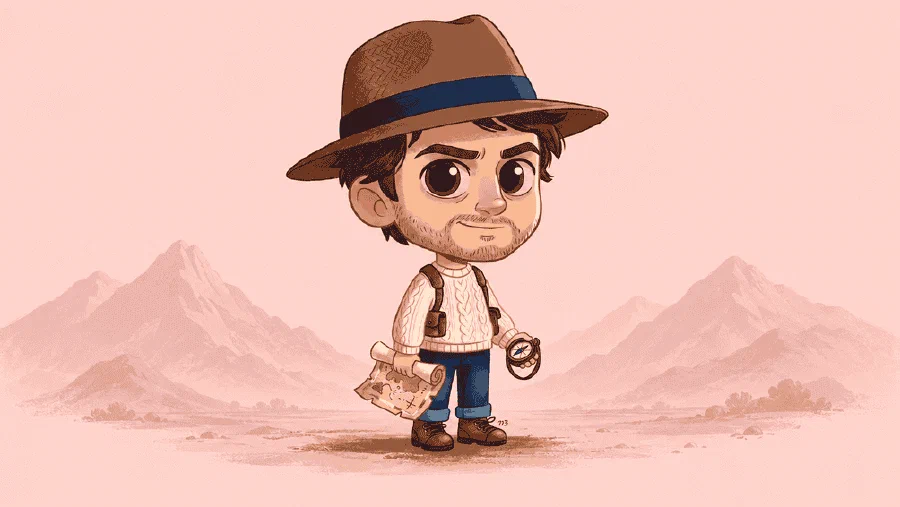
What the narrative insists on building - especially in Uncharted 4 - is a character with real depth. Nathan grew up an orphan, spent his childhood in orphanages, ran away at fifteen, became a thief out of necessity, and embraced adventure as an alternative to the life he didn’t have. Even his last name is a convenient fiction: he named himself “Drake” claiming descent from the privateer Francis Drake. His birth name was Morgan. Identity was a choice, not a heritage.
It’s a background that would perfectly justify a morally ambiguous character, someone who killed to survive, who makes tough decisions, who carries weight. Naughty Dog had all the material at hand.
Across the four games, he wipes out approximately between 800 and 1,200 people depending on which statistical walkthrough you check. The narrative never pauses to comment on this. Drake never has nightmares. The game carries on.
The dissonance is so colossal it became a meme. And yet Uncharted is great - which says everything about our brain’s tolerance when the gameplay is good enough.
2. Tomb Raider (2013) - the trauma that lasted exactly one cutscene
The Lara Croft reboot of 2013 was explicitly built around an origin arc: this Lara has never killed anyone. She is fragile, scared, human. There’s even a memorable cutscene where she kills an animal to survive and cries afterward.
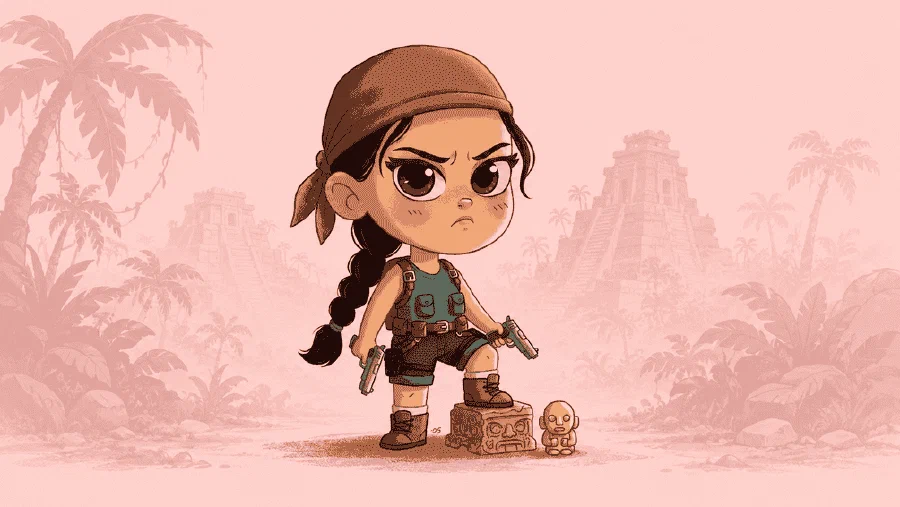
The next scene is a shootout where you eliminate twenty mercenaries in a warehouse.
Crystal Dynamics noticed the problem during development, and producer Ron Rosenberg said at the time that they intended to make players “want to protect” Lara. The result was a character who apparently overcame the trauma of killing in about four minutes of gameplay.
Character development arcs. They work. (Do they work?)
3. God of War (2018) - the father who crushes skulls and teaches lessons
Kratos spent three games being literally the personification of distilled Greek violence. He killed gods, titans, demigods, mythological creatures, and opened Pandora’s box without remorse.
In the fourth game, he wants to teach his son to be better than he was. To not be angry. To not kill on impulse.
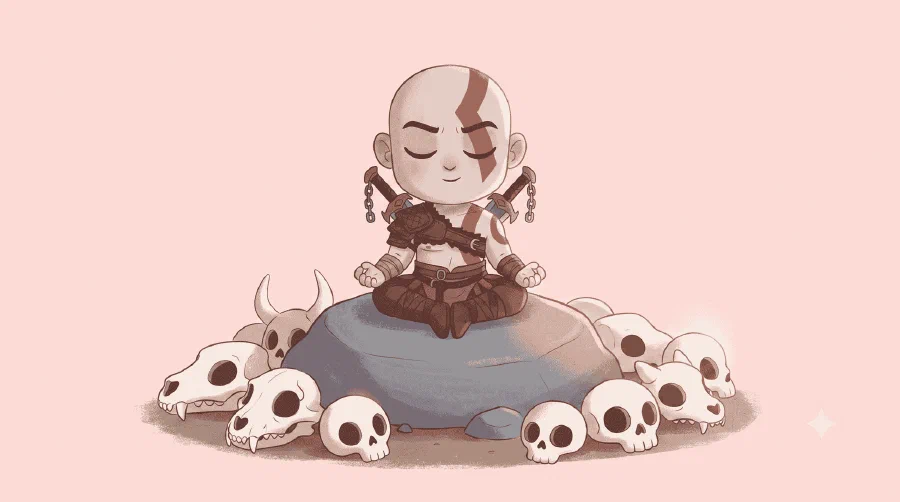
And then you spend the entire game wiping out hundreds of Norse enemies with an axe that returns to your hand like a deadly boomerang while Kratos explains to Atreus the importance of emotional composure.
The dissonance here is intentional and, in a way, is the exact point - Kratos knows he’s a monster and tries not to pass that on. It’s poetically beautiful and mechanically hilarious at the same time.
4. Red Dead Redemption 2 - Arthur Morgan and the honor system
RDR2 has one of the richest narrative systems ever placed in a game. Arthur Morgan is a character with genuine depth, real moral conflicts, and one of the most beautiful goodbyes in gaming.
The game also has an honor system that tracks your actions and affects the world around you. You can be an honorable outlaw or a ruthless monster.
What the game doesn’t comment on is that the main mission frequently forces you to kill dozens of people regardless of which Arthur you’re building. Honor rises and falls. Bodies keep piling up. Arthur writes in his journal about redemption.
The dissonance here is almost philosophical: what does it mean “to be a good person” when the structure forces you towards violence as a condition of progress?
(Taleb would have a lot to say about this. But not today.)
5. Far Cry 3 - the game that noticed the problem and didn’t know what to do
Far Cry 3 is aware of the problem: Jason Brody starts as a scared playboy and transforms into a violent predator throughout the campaign. The narrative even comments on this. The villain Vaas is basically the mirror of what Jason is becoming.

The problem is that the game celebrates the transformation instead of critiquing it. The more violent you are, the more skills you unlock. The gameplay rewards you for exactly the behavior that the narrative supposedly questions.
Far Cry 3 wanted to be a critique of violence in action games and ended up being a very good action game about violence. The message and the medium mutually canceled each other.
6. The Last of Us - Joel and the question the game doesn’t want to answer
Joel is presented as a pragmatic survivor, morally gray, who did terrible things to stay alive. His relationship with Ellie is what humanizes him. All of this is built carefully.
What remains implied - and that’s the great tension of the game - is that Joel clearly carries some level of PTSD after losing his daughter. He is a broken character who found a reason to keep going.
But mechanically, Joel is a highly efficient killing machine. The visual impact of combat is brutal and satisfying. You smash enemies with bricks and iron pipes with disturbing realism.
The dissonance in TLoU is subtler than in other cases - it’s part of the artistic intent. But it’s dissonance just the same: gameplay says violence is fun, the game says violence is trauma, and these two states need an unspoken agreement to coexist.
7. GTA V - three protagonists, zero coherence
Grand Theft Auto has never pretended to be narratively coherent, which is actually its greatest advantage. But GTA V deserves mention for taking dissonance to an almost artistic level.
Michael De Santa goes to therapy. Talks about his traumas. Has a dysfunctional family that he genuinely tries to fix. His wife has a lover. His kids initially don’t care about him. He’s a character with real nuances.
Michael De Santa can also, literally after leaving therapy, run over pedestrians, blow up a gas station, and escape from the police in a helicopter within the span of five minutes.
Rockstar isn’t trying to resolve this. They’re using dissonance as social commentary on violence, consumerism, and the sandboxing of American life. Or it’s just absurd fun and I’m over-intellectualizing.
(Probably both.)
8. BioShock Infinite - Booker DeWitt and the violence that doesn’t get explained
BioShock Infinite is a game that clearly wants to be more than a shooter. It has narrative ambition, social critique, a rich and disturbing universe. Ken Levine’s script is genuinely brilliant at several moments.
The narrative setup is audacious: Booker DeWitt was a Pinkerton agent during the Wounded Knee Massacre - actively participated in the mass murder of Native Americans and never properly processed what he did. To pay off gambling debts, he sold his own newborn daughter, Anna, to a man named Comstock. What he didn’t know - and what the player only discovers at the end - is that Comstock is himself, a version of himself in another timeline. Anna grew up trapped in a floating tower, became Elizabeth, and has the power to open Tears between dimensions - a skill the game naturally uses as combat mechanics.
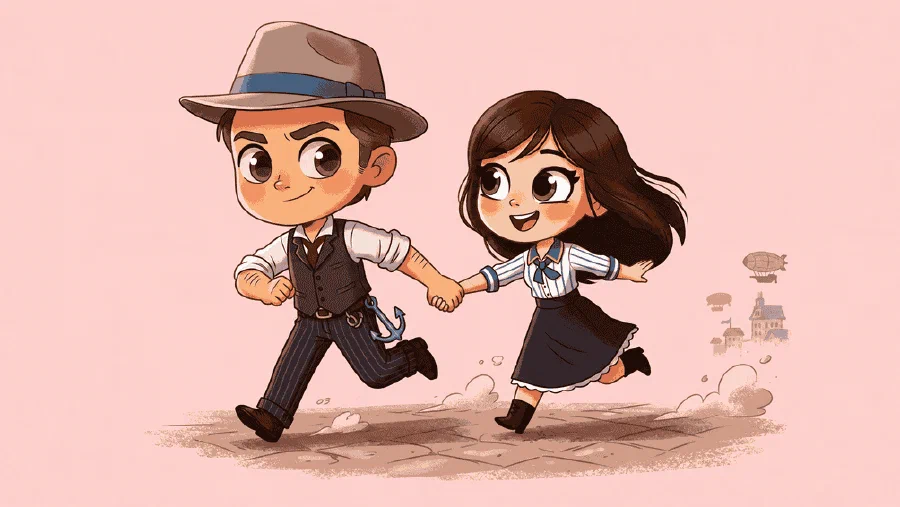
It’s one of the most elaborately crafted narrative architectures ever placed in a shooter. A man broken by guilt - guilt for massacring an entire people and for selling his own daughter. Then he decides he will rescue this daughter in a floating city driven by religious fanaticism and racial supremacy.
And then you have Booker DeWitt, former Pinkerton agent with traumas of massacre, whom you control throughout the campaign destroying entire armies with heavy powers and weapons.
The narrative tries to justify the violence as a consequence of Booker’s past - he is a violent man, that’s the point. But the gameplay rarely makes you feel the weight of this. You feel power. Satisfaction. Fun. Elizabeth reacts in horror during the first combat scenes - and after a few shootouts, she simply starts throwing ammo at you mid-battle, as if she accepted the deal.
The game wants you to feel bad about the violence and gives you mechanics that make violence delightful. Maximum dissonance, impeccable production.
9. Spec Ops: The Line - the only game that used dissonance as a weapon
I need to include this because it’s the obligatory counterpoint.
Spec Ops: The Line is a third-person military shooter that seems generic in the first twenty minutes. And then it starts deliberately and disturbingly using ludonarrative dissonance against the player.
Every gameplay mechanic that should be satisfying - killing enemies, advancing, “being the hero” - progressively becomes associated with horrible consequences that the narrative forces you to face. The game doesn’t let you ignore what you’re doing.
It’s uncomfortable. It’s genius. It’s the only time I remember a game using dissonance not as an unresolved problem but as an intentional narrative tool.
Required reference for any serious discussion on the subject. And it’s a game that most people didn’t finish because they found it “too depressing”. (Which is, in itself, another layer of dissonance.)
10. Cyberpunk 2077 - V and the identity that disappears when you need it
V is constructed as a mercenary who chooses her jobs, has her own morality depending on her choices, and is literally fighting for the survival of her own identity - there’s a chip in her skull with Johnny Silverhand’s consciousness trying to take over her body.
Existential identity crisis. Rich narrative. Deep world.
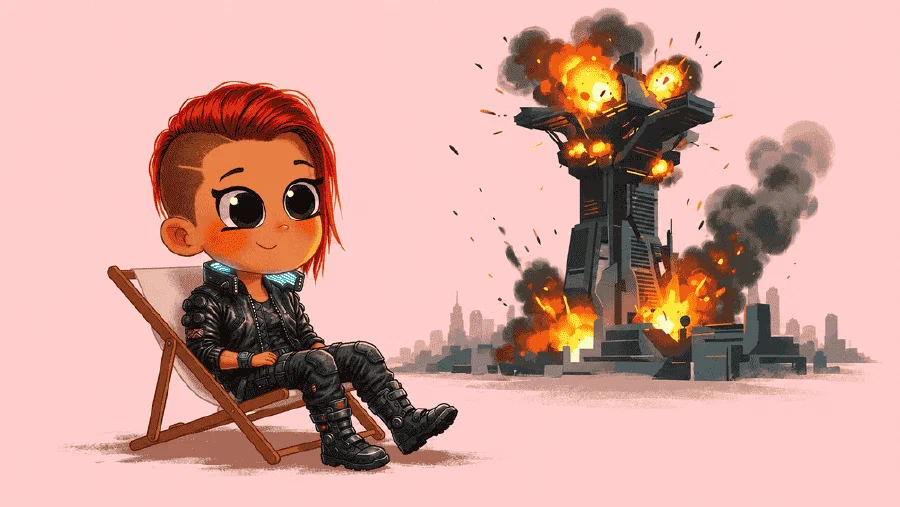
V can also randomly kill civilians on the street without the main narrative commenting on it a word. The identity chip doesn’t blink. Johnny Silverhand has no opinion on the pedestrian you just ran over.
Night City is huge and detailed and alive, and much of it exists in a state of complete irrelevance to the story being told. The dissonance here is less about violence and more about scale: the game built a world too big for its narrative to keep up.
So - is this a problem?
It depends on what you want from a game.
If you want perfect coherence between mechanics and narrative, the list of games that deliver it is short and usually involves titles with very restricted or very abstract gameplay. Journey, Papers, Please, and Disco Elysium are good examples. Works that either eliminate the conflict by reducing player agency or transform agency itself into narrative commentary.
If you want fun with a story that goes well with it and doesn’t need to be inspected closely - well, practically any blockbuster from the last decade is available.
Ludonarrative dissonance is not a script failure. It’s the natural friction between two languages that say different things at the same time. It’s like reading a book with a soundtrack from another genre: you can learn to ignore the conflict, you can learn to enjoy it, or you can stop reading.
The plumber will continue obliterating creatures in the Mushroom Kingdom. And you will continue playing.
(So will I.)
Disclaimer
Super Mario Bros. and all related characters are registered trademarks and property of their respective owners. Images used for criticism and informative analysis.
