The internet's court
Every week the internet picks a culprit, sets up the court, hands down a sentence and calmly goes to lunch. The defendant changes, the jury changes, the process is always the same and nobody asks who paid for the ticket.
Then some Korean criminologists went to ask those in the stands why they were there. The answer is less noble than we might like.
The jury likes the show
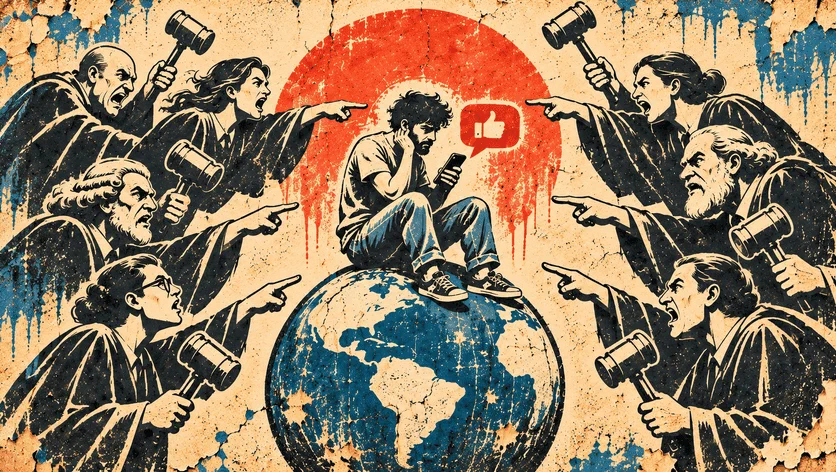
The study is by Dosun Kim and Yeon Soo Kim, criminologists at Dongguk University in Seoul, published in 2026 in Computers in Human Behavior and summarized by PsyPost. They interviewed a representative sample of 1,000 South Korean adults about internet justice: public exposure, group harassment, doxing and the rest of the menu.
They measured two things. The first is schadenfreude (how I love that term!), that German word for the pleasure of seeing someone else suffer. The second is moral grandstanding (moral grandstanding, in the original), which is using moral argument to polish your own image and comes in two flavors:
- the prestige kind, from those who want to be seen as a good, sensitive person;
- the dominance kind, from those who want to boss people around, assert authority and humiliate dissenters; and
- the third flavor, which the study didn’t measure, from those who just want a reason not to work at three in the afternoon or to skip the daily stand-up.
Then they split people into three groups: those who never participated, those who only watch (search for and read content about the “offender”), and those who get hands-on, commenting, posting or spreading the target’s personal data.
Active participants had the highest scores of schadenfreude, prestige grandstanding and belief that internet justice works. And, both among the active participants and among the watchers, the more someone enjoyed others’ misfortune and the more they wanted to appear as a good person, the more they thought the lynching was an effective tool.
Translation without anesthesia: the people who most believe cancellation brings justice are precisely the ones who enjoy the spectacle the most.
Convenient, isn’t it?
Before someone cancels me for this
Read the fine print, because it would be ironic for me to lynch a study about lynching.
The research is a questionnaire, applied at a single moment, so you can’t say what causes what. The authors themselves note that causality could be reversed: participating in a lynching might increase one’s taste for other people’s misfortune. People may also have dressed up their answers to look nicer (of all topics, a questionnaire about people who want to look nice is especially vulnerable to that).
And “effectiveness” here is the opinion of participants. The study doesn’t show that the internet’s court reduces crime or achieves justice, only that those enjoying it think it’s working. Which also describes half the relationships I know.
There’s an interesting finding among those who never participated. In them, what correlated with schadenfreude was dominance grandstanding. The authors call this exploratory because that group was small, but their hypothesis is tasty: some people approve of lynching from afar because it symbolically punishes the wrongdoer and reaffirms their own moral superiority without getting their hands dirty.
The armchair fan of cancellation. Doesn’t go on the field, but curses the referee with conviction.
Nothing new under the sun, just the Wi‑Fi
Michel Foucault opens Discipline and Punish by describing, with details I do not recommend before lunch, a public execution in 18th-century France. The ordeal was a spectacle and the crowd was part of the punishment.
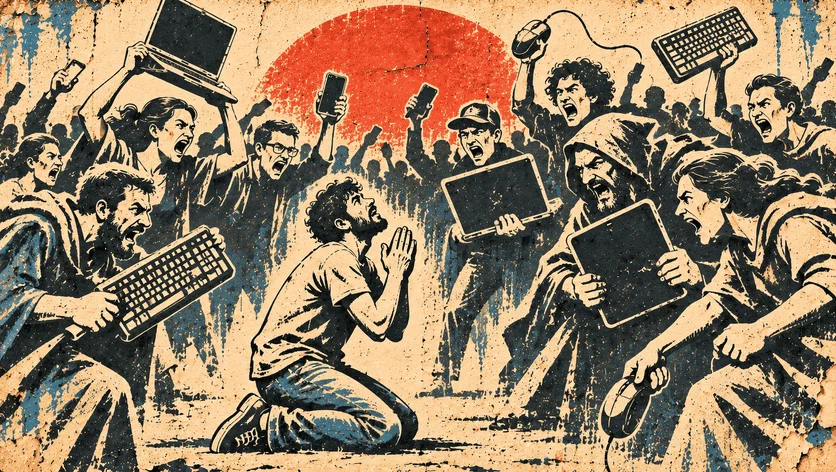
We swapped the square for the timeline and thought we had evolved.
By the way, Black Mirror already did this episode (“Hated in the Nation”, 2016), where the hashtag picks who will die. Back then it seemed like an exaggeration. Today it reads like a documentary with a bigger budget.
The detail the Korean study makes clear is the incentive. Virtual lynching is cheap for participants and costly only for the lynched — pure behavioral economics. You get the hit of pleasure, you earn a little badge of being morally correct in front of your followers, and you pay nothing if the accusation is wrong. Taleb would call this a lack of skin in the game. I call it a Big Brother Brasil–style elimination with the whole country voting and no prize at the end.
And when the defendant is half the country?
So far we’ve talked about individuals. The problem is the same machine works with groups, and then the issue becomes politics.
Brazil just came out of an election decided in the second round by 51.8% to 48.2%. There’s an audience left on both sides of the ring to watch the other side be condemned. I won’t say who’s right (this site doesn’t have the emotional infrastructure for that), but anyone with a family WhatsApp group knows the atmosphere isn’t for hugs.
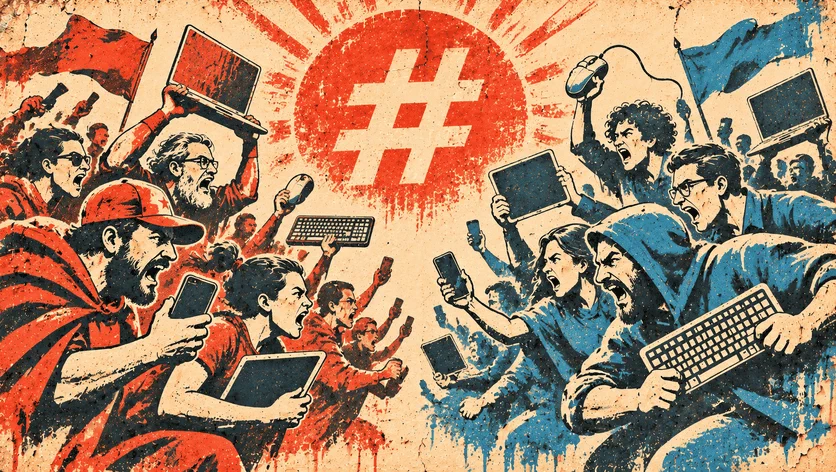
A new study by Melissa Pavetich (Heriot‑Watt University, Dubai) and Sofia Stathi (University of Greenwich), published in Personality and Social Psychology Bulletin, looked into what defuses this fight. They ran five experiments with 1,541 people in the UK, the US and Canada.
Their clever move was to change the question. Instead of measuring what you think of the other side, they measured what you think the other side thinks of you.
Participants read fake posts, in the style of the old Twitter, supposedly written by voters from the rival party. In one group, the posts called the participant’s party “animals and brutes with no self‑control.” In the other, “sophisticated.” A bit of praise, a bit of insult, basically a Sunday lunch.
Those who read that the other side saw them as people felt less hostility and were more open to negotiating, compromising and working together. Predictable so far.
The trick is in the pathway. The researchers tested anger, disgust and empathy, and the one that usually did the job was disgust. Feeling treated as human reduces moral disgust toward the opponent, and that opens space for conversation. Anger and empathy did not make a statistically significant difference in most tests (empathy only appeared as a parallel pathway in one of the five).
Pavetich herself told PsyPost she expected empathy to do most of the work. In her loose translation: reducing a negative moral reaction may matter more than building positive feelings.
No one needs to love their brother‑in‑law. They just need to stop thinking he’s contagious.
Disgust fuels the tribunal
Put the two studies together and the picture gets clearer.
Virtual lynching provides pleasure and status. To work, it needs a defendant who seems less than human, because nobody feels schadenfreude watching a nice neighbor trip. Moral disgust turns a person into a legitimate target, whether an individual or half an electorate.
And the mechanism feeds itself. According to PsyPost’s summary, a 2020 US study showed that Democrats and Republicans greatly overestimated how much the other side hated and dehumanized them, and those who believed that supported more vindictive actions against democratic norms. Earlier research also indicates that those who feel dehumanized tend to dehumanize back.
I think you hate me, so I’ll hate you first, and that saves us time.
Nelson Rodrigues used to say that any unanimity is stupid. The internet’s court produces unanimity on an industrial scale — but in two bubbles that never meet.
So the solution is to blow kisses at the opponent?
Hold on. The authors themselves pour cold water on the idea.
The effects were small to moderate. Pavetich warns that this, by itself, doesn’t erase partisan hostility, and it’s useless to go around saying “the other side sees you as human” if it’s not true. The signal needs to be genuine, which rules out much political marketing.
The study was also done in countries dominated by two major parties; Brazil is a multiparty amusement park that turns into Fla‑Flu with every second round. You can’t import the result with a guarantee. The effect was also more consistent when people felt a moderate threat to social cohesion. The authors speculate that with too much threat many people go defensive and dig in (among conservatives, the effect extended even to high threat).
Still, the clue is useful. If disgust feeds the tribunal, winning the argument helps little to defuse the fight. It helps more to stop treating the opponent like trash in public, even if you utterly disagree with them. In the researcher’s words, signals that we see the other side as fully human can lower the temperature more than winning the argument.
For anyone with an X account, that’s practically a revolutionary idea.
You’re the ticket
The internet’s court will stay open, because the business is too good. The audience gets pleasure and status, the algorithm gets engagement and the defendant gets the bill.
It remains to decide whether you buy the ticket. Next time you feel the urge to share someone’s misfortune with a witty comment, ask: am I doing justice or just farming aura on other people’s heads?
(And I, who just wrote a thousand‑odd words to seem morally superior to those who think they’re morally superior, prefer not to answer.)
To check I’m not making anything up:
- Reportagem do PsyPost sobre o estudo coreano: The psychological motives driving internet justice and public shaming
- Reportagem do PsyPost sobre o estudo da humanização: Study finds a specific emotional route from feeling humanized to political compromise
- Artigo original de Kim e Kim, Computers in Human Behavior, 2026: Perceived effectiveness of online vigilantism: The role of schadenfreude and moral grandstanding
- Artigo original de Pavetich e Stathi, Personality and Social Psychology Bulletin, 2026: Bridging the Political Divide: Meta-Humanization and Moral Emotions Shape Partisan Reconciliation
- Resultado do segundo turno com 100% das urnas apuradas: Lula é reeleito presidente e supera Flávio Bolsonaro (DGABC)
