Shun: the most lethal knight
There’s a cosmic injustice that happened in the 90s, and we just accepted it because we were kids, had Cheetos (or ‘deditos’) on our fingers, and thought that solving problems by yelling the name of your attack was a viable life strategy.
Shun of Andromeda was treated as the fragile knight. The sensitive one. The nice guy. The one who cried. The one who needed to be saved by his older brother, because apparently every anime from the 80s and 90s needed at least one emotionally functional character to be humiliated by the script.
But there’s a slight problem with this reading.
I believe Shun might be the most lethal Bronze Knight of all. I thought that before, but I see there are more people who believe it too. I watched this brilliant video on YouTube to strengthen my confirmation bias.
This isn’t a revisionist attempt to virtue-signal over a classic anime. After all, virtue-signaling about Saint Seiya in 2026 would be such a specific niche that there’s probably an abandoned forum on Orkut (yes, I’m from the Orkut era) dedicated to it. Just look, seriously, at what he can do.
The pacifist who could destroy you
Shun is not weak. Shun is controlled.
And there’s a brutal difference between the two things that most of us learned the hard way, usually with someone quiet that we underestimated until the moment we shouldn’t anymore.
The character doesn’t avoid fighting because he can’t. He avoids it because he knows exactly what happens when he stops avoiding. It’s the difference between someone who doesn’t know how to fight and someone who knows too much - and thus prefers not to start.
On the surface, everything conspires for the wrong reading: long hair, pink armor, chains (chains!), a soft voice, excessive compassion, and that energy of someone who would apologize after being run over (me in life). But beneath this aesthetic lies a nuclear bomb.
He’s not the knight without strength.
He’s the knight with too much strength and too much awareness. Which, let’s face it, is terrible for entertainment. No one wants to see an emotionally mature character resolving conflict through dialogue. We want trauma, explosions, and someone screaming, “I’m going to kill you!” with a trembling voice.
In other words: Ikki of Phoenix. Badass.
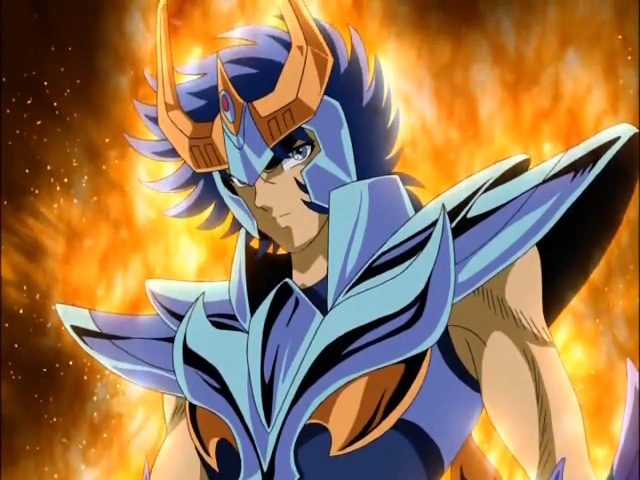
The problem called Ikki
Ikki is absolutely wonderful.
Ikki enters the scene as if he were written by a teenager listening to Linkin Park before Linkin Park existed. Dark, solitary, aggressive, traumatized, powerful - and he has a phoenix as his symbol. It’s practically impossible to compete with that.
While Shun represents restraint, Ikki represents catharsis. While Shun tries not to hurt, Ikki arrives to hurt with administrative efficiency.
And that creates a perception problem: every time Ikki shows up to save Shun, the audience concludes that Shun needed to be saved because he was weak. But maybe the logic is completely the other way around.
Maybe Shun needs saving from his own limits. Because when he reaches the point of no return, he doesn’t “fight better.”
He erases the enemy from existence.
The chain is not the main weapon
The Andromeda Chain is one of the most interesting weapons in Saint Seiya - and probably the most underestimated - precisely because of its dual purpose: it defends and attacks. It protects and binds. It detects and punishes.
It’s a perfect weapon for someone who doesn’t want to hurt but doesn’t intend to die out of politeness. 🔗
(I mean, it’s a perfect weapon for whoever the script decided should seem decorative.)
But the chain isn’t the real problem. The real problem is what Shun does when he loses the chain.
The Nebula Storm is the moment the character stops negotiating with his own morals. It’s the instant when “please don’t make me” turns into “now you made me.” And when that happens, the script usually ends the fight quickly - because there’s a limit to how long you can keep on screen the character who should be the sensitive one dismantling the entire power hierarchy of the series.
Aphrodite of Pisces learned this the hard way.
Aphrodite didn’t lose to a loser
The battle against Aphrodite is one of the greatest proofs that Shun was systematically underestimated.
Aphrodite is not just some random henchman with the name of a secondary constellation and an expected lifespan of three episodes. He’s a Gold Saint. One of the twelve. He occupies one of the zodiac houses, has refined technique, aesthetic presence, and that annoying confidence of someone who knows he’s too beautiful to die early.
Shun wins. Without armor. Struck by a real devilish rose.
Nebula Stormmmmmmmmm! (sorry, I couldn’t help it)

It wasn’t because Ikki showed up. It wasn’t because Seiya shouted from the back. It wasn’t because Athena sent a power-up via cosmic courier. Shun wins because when he finally accepts to fight for real, he is terrifying.
That’s the point the collective memory completely missed. The victory against Aphrodite isn’t a sentimental exception. It’s a structural revelation - the script saying, between the lines: “this boy you treat as fragile was holding the handbrake all this time.”
Shun’s uncomfortable masculinity
There’s also a more uncomfortable layer here. One that may explain why the popular reading was so misguided for so long.
Shun never fit into the classic model of the male action hero. He’s not brutish. He’s not impulsive. He’s not competitively idiotic. He doesn’t solve anything based on “I’m more of a man than you” - this “sophisticated” philosophy that has driven much of humanity thus far and explains half of the planet’s geopolitical problems.
Shun is compassionate. And that’s been confused with weakness.
Because culturally, there’s still a pathetic difficulty separating kindness from impotence. If someone doesn’t want to destroy the other, we assume they can’t. It’s a mistake. Nassim Taleb would call it confusing absence of evidence with evidence of absence - just with a version involving Cheetos and TV Manchete.
The beautiful work “Ender’s Game” also shows this. Andrew, despite being a strategic genius, has such deep empathy that it becomes his greatest weapon and torment. He understands his enemies so well that he almost loves them before destroying them - and it’s precisely why he gets fooled, commits planetary genocide, and is later devastated. (spoiler, but the book is pretty old, right?)
The wolf that’s constantly snarling might just be loud. The one that stays quiet in the corner might be the one who knows exactly where to bite. Case in point: Shun and Andrew.
The wrong stoic
The character would be, in a more interesting reading, a specific form of stoicism.
Not the stoicism of a black T-shirt, a quote from Marcus Aurelius on Instagram, and a “high performance” course sold by someone who calls burnout a weak mentality. (Shoutout to LinkedIn coaches!) I mean something else.
I’m talking about the discipline of not immediately reacting to impulse. The ability to suffer without turning suffering into a spectacle. The refusal to use power just because it’s available - which, let’s face it, is the kind of maturity that most people never developed and probably never will.
Shun is not stoic because he doesn’t feel. He feels too much. And it’s precisely why he controls himself. That’s why he is stoic.
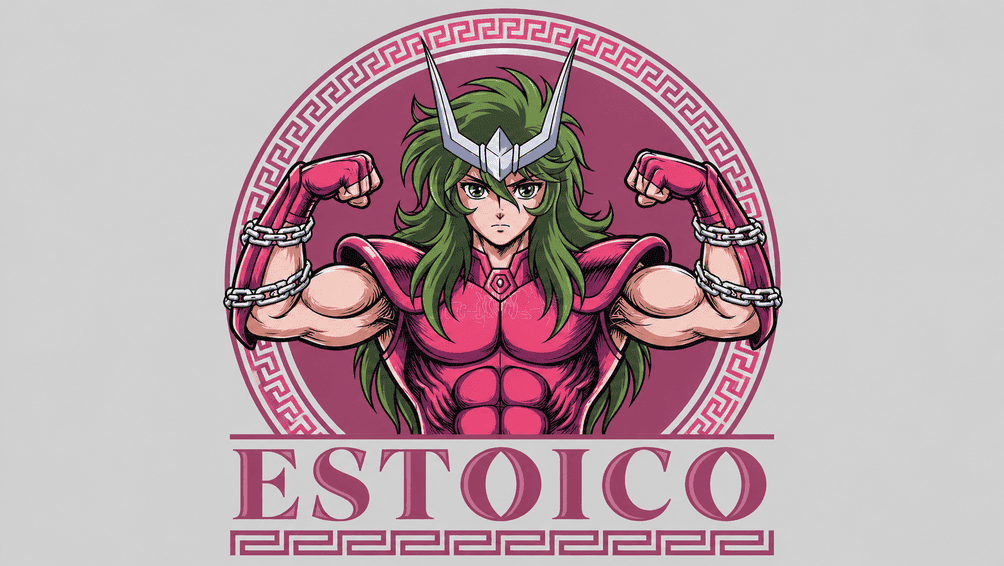
This detail matters. The dumber version of modern stoicism confuses self-control with emotional amputation. Shun isn’t a stone. He’s the opposite: someone so filled with affection that he needs to build a rigorous ethic to avoid becoming a walking weapon.
It’s almost beautiful and it’s also somewhat tragic.
Like almost everything worthwhile in Saint Seiya, by the way. Poor Seiya.
The character the adaptation couldn’t protect
There’s a difference between Shun as an idea and Shun as a narrative habit.
As an idea, he’s fascinating: a pacifist warrior, extremely powerful, who rejects violence not out of cowardice but principle - and when that principle gives way, what’s left is devastation.
As a narrative habit, over time, he became the guy who needs to get beaten up for Ikki to show up with his own soundtrack . And then the industry does what the industry always does: simplifies what was ambiguous. Transforms delicacy into fragility. Transforms pacifism into incompetence. Transforms restraint into dependence.
It’s the narrative equivalent of looking at an ABS brake system and saying, “this car is weak because it doesn’t skid.”
No, my traumatized young grasshopper from TV Manchete.
It was just designed not to kill everyone on the first curve.
Shun was the warning
The great beauty of Shun is that he subverts the most basic fantasy of power in fighting anime: the classic hero wants to get stronger to defeat bigger enemies.
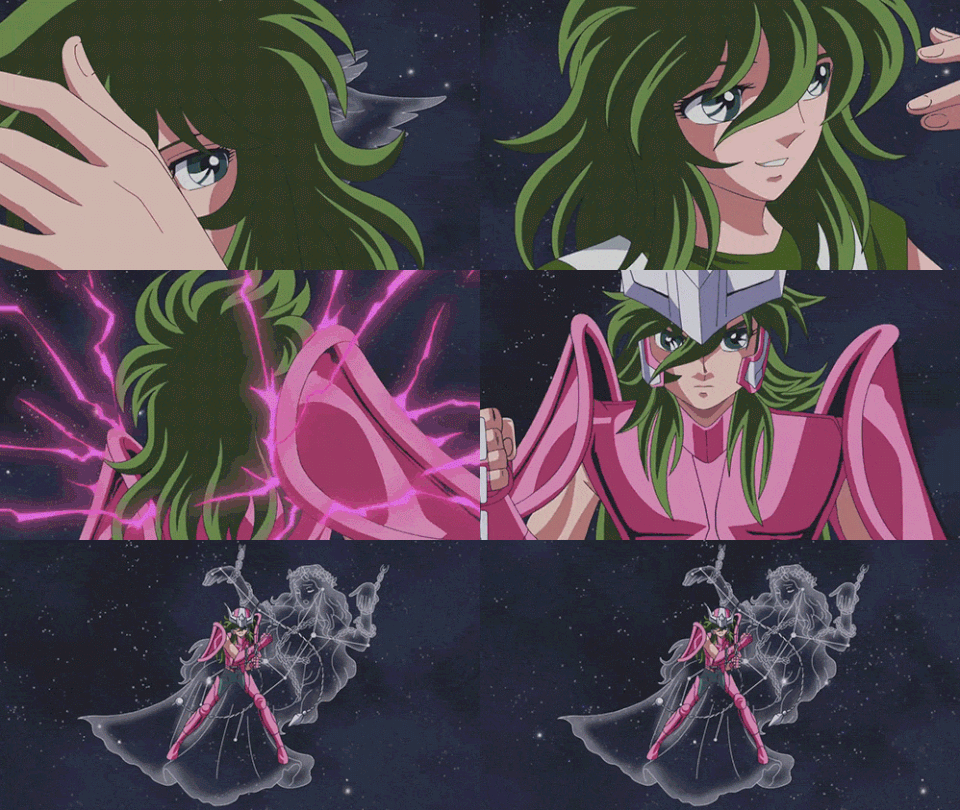
Shun is already strong. His drama is entirely different: how to continue being good when you have enough power to stop being?
This is more interesting than it seems - and has more to do with the real world than any technique with a name yelled in Japanese.
Because power without compulsive aggression is unsettling. He doesn’t perform a threat. He doesn’t need to convince anyone. It’s there, quietly, waiting for the world not to force him to prove anything.
But the world always demands.
The world has that irritating habit of poking exactly those trying to find peace.
(I’m going to pretend that I didn’t write this paragraph thinking of specific situations in my own life.)
In the end, Shun is lethal not because he enjoys violence. He’s lethal because he understands its weight - which, by the way, is the only valid reason for someone to be dangerous.
The most dangerous knight isn’t necessarily the one who bursts in screaming, burning cosmos, and promising revenge until the next commercial break.
Sometimes, the most dangerous one is the one who asks you to stop. Once. Twice. Three times.
And then stops asking.
Shun wasn’t the weak link of the Bronze Knights.
He was the red button with green hair - and we were deceived our entire childhood.